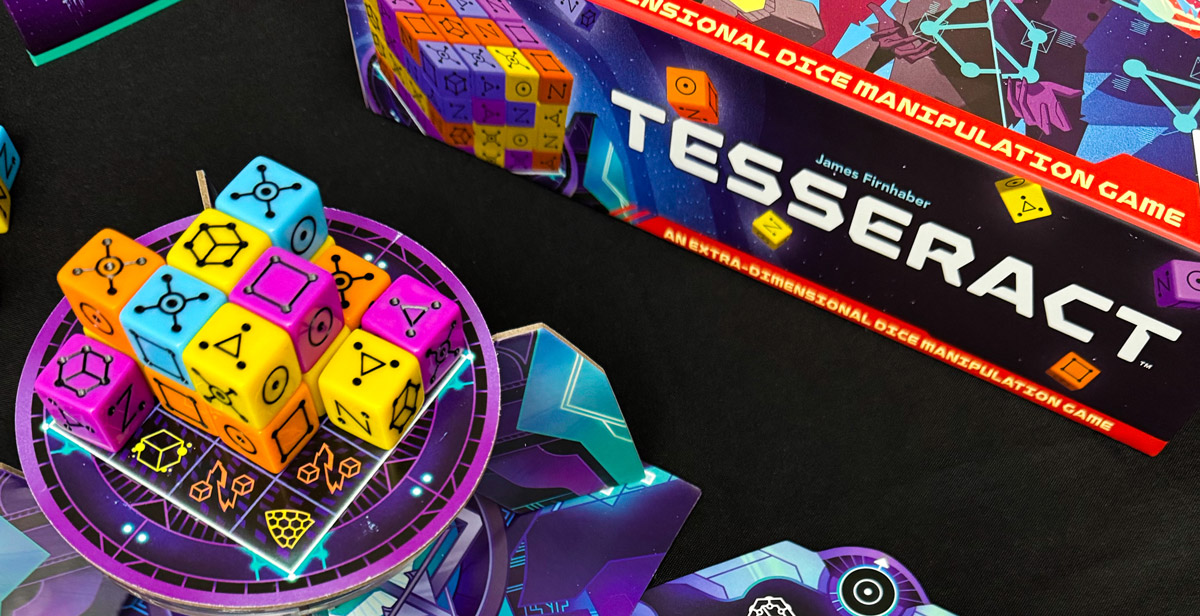
Like most board gamers, I am basically a big kid stuck in an adult’s body. So obviously, when I saw Tesseract’s gimmicky cube tower that spins on a lazy susan, I knew I wanted to play it. Read our review below the table to see if it might be a good fit for you.
| Player Count | 1-4 | Age Range | 14 and up |
| Time to Play | ~60 minutes (official) | Setup Time | ~15 minutes |
| Mechanics | Set Collection, Dice Manipulation, Puzzle | Vibe | Energetic, Cooperative |
| Designer/ Developer | James Firnhaber, Curt Covert | Publisher | Smirk & Dagger Games |
| Illustrator | Denis Freitas | Graphic Designer | Curt Covert, James Firnhaber |
| Table Space Needed | 28" x 28" | # of Cats Fit in Box Lid | 1 Large Cat |
| Component/ Production Quality | Medium | Rule Book Quality | Medium |
| Box Quality | Medium | Storage Design | High |
| Theme Quality | Medium | Graphic Design Quality | High |
| Interactivity Level | High | Hostility Factor | Low |
| Complexity/ Strategy | Medium | Replayability | Low |
| Originality | 8 | BGM Rating/ Recommendation | Nicole: 6.5; Megan: 7.2 |
The game’s core mechanisms were also attractive to me—like Sky Team, Tesseract consists of co-op dice drafting, manipulation, and placement. However, Tesseract feels quite different from Sky Team. While each player is responsible for their own turn, communication is encouraged.
Objectives of Tesseract
Tesseract is about disarming a dangerous alien artifact known as—wait for it—the Tesseract, which manifests for us as a rad cube of dice. Turns consist of drafting dice from the Tesseract, using cards and actions to manipulate their face values, giving dice to other players, and playing them to a central “containment” board in which all colors and values will need to be played to win.
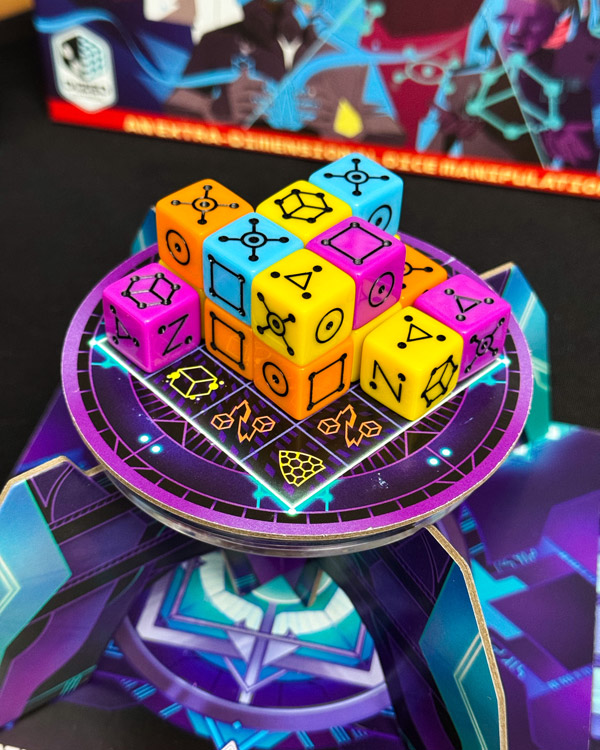
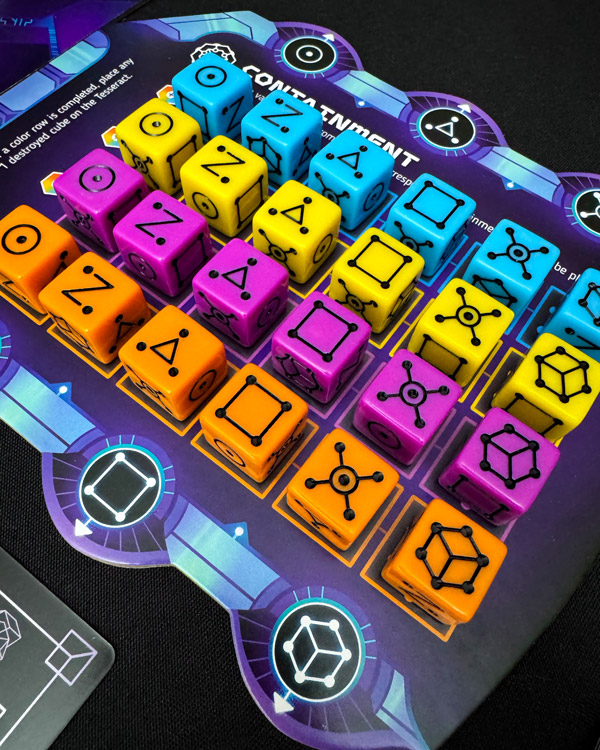
After each player’s turn, the lowest die on the cube will be rolled to see which slot it will reside in beside the containment board in the “primed area.” If three of the same value dice accumulate, a “breach” has occurred. At 7 breaches, the Tesseract explodes! Well not literally, but you do literally lose.
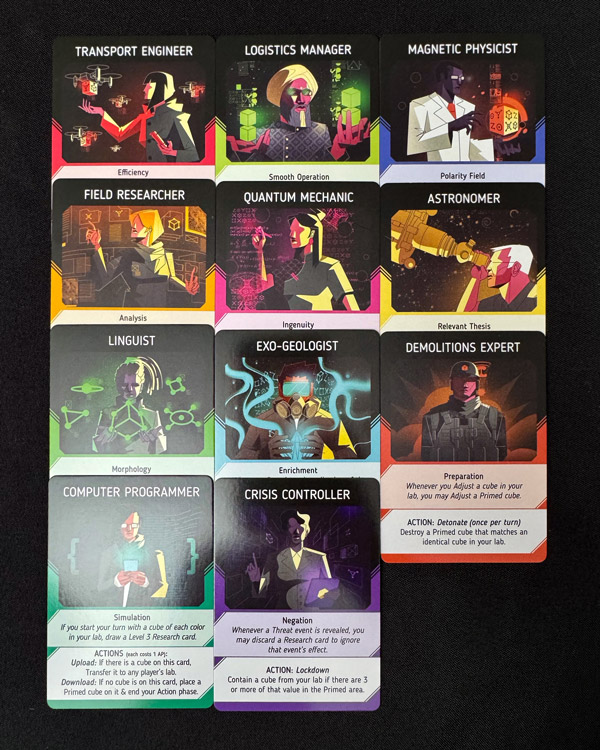
Players will get asymmetric character abilities that will help them coordinate with other players. For example, the player who is the Computer Programmer will get a “level 3” research card if they start their turn with a cube of each color on their player board. (Research cards can be very handy… almost so handy that using them feels like cheating sometimes.) The Computer Programmer can also take a special action: place a cube on their character card for later transfer to another player’s board.
Components
The components are pretty rad. The dice cube on the stand is just cool. It just is. I enjoy setting it up, I enjoy turning the dice around, I enjoy placing the dice, I enjoy futzing with the cube to keep it orderly on its stand. And! This is one of those rare games that actually comes with a decent box insert. The card quality is only so-so, but the game is a good value, all things considered.
Fun Factor
Tesseract is a fun efficiency puzzle, and I am lucky to have played Megan, a logistics genius. But having someone that good on your team ironically makes the game feel a little too easy—we didn’t feel the tension that we might lose which is a big part of the fun in this breed of co-op. Now, we have only played with dice mats 1 and 4, and difficulty goes to 8, so it’s possible our sense of invincibility may evaporate upon playing the 8.
Replayability is up in the air on this one. I would have liked to see more variation in the required board state at the end of the game. The variation relies mainly on asymmetrical player powers and varied negative effects of exposing the base layer dice mat under the Tesseract. Are we spoiled by the astonishing variability designed into co-op campaign games like Sky Team and Dorfromantik? Maybe.
Where to Buy
Prices are fetched periodically and may not reflect the current price. Links may be affiliate links.


